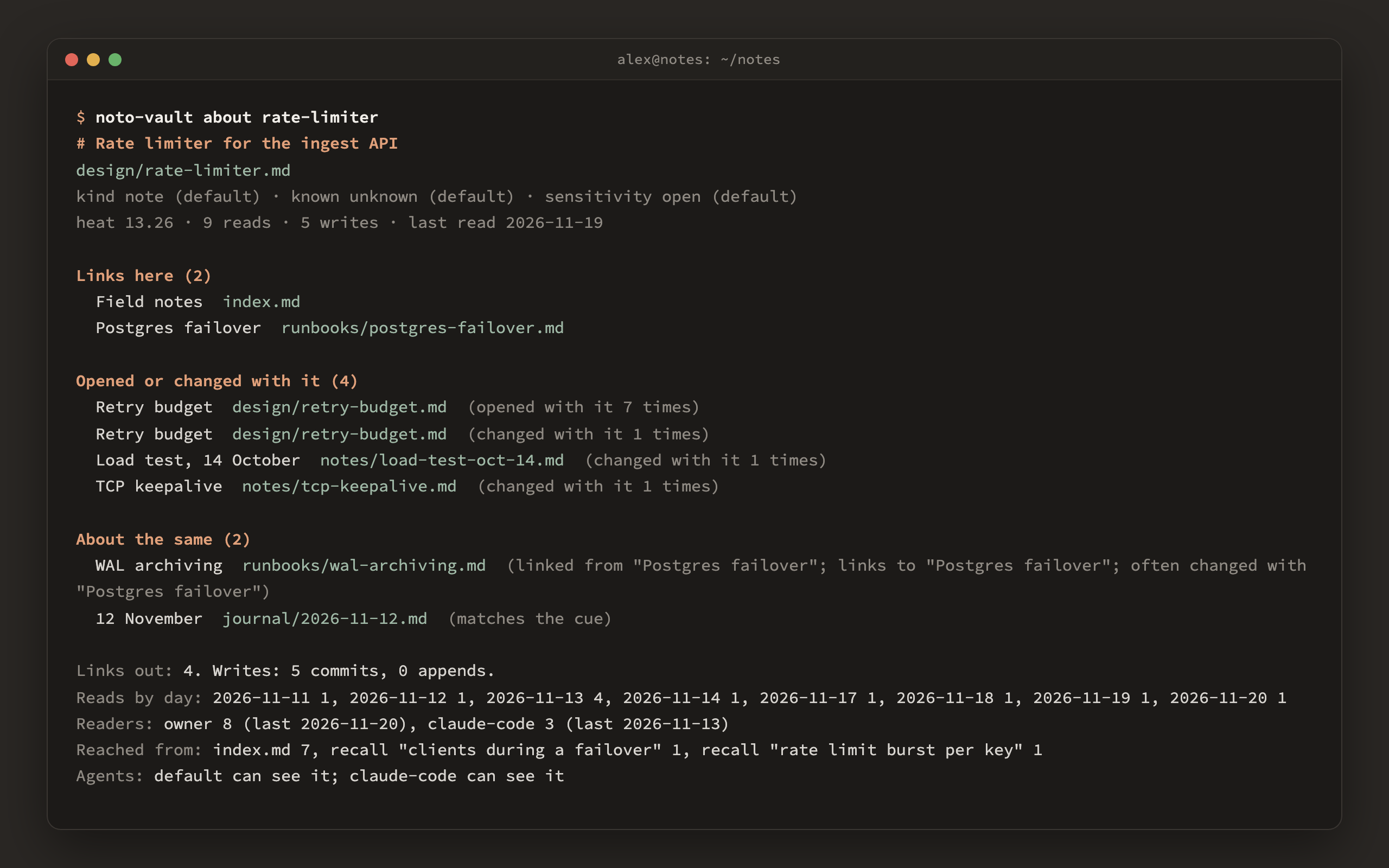
vault is for people who keep their notes in git as plain Markdown files and let coding agents read them. It turns that folder into memory the person and the agents share, without changing what the notes are. It adds one resolver for every kind of link, an index that can always be rebuilt, a record of what was read, keys that say what each agent may see, recall within a budget, and changes an agent proposes and a person accepts. Agents reach it through the noto-vault command line or its MCP server, and Noto embeds it.
The notes stay the only source of truth. Nothing written into a note depends on this package to be read: a link is still [[a note]] or [text](a/note.md), and git still holds every write.
- For
- people who keep Markdown notes in git and let agents read them
- Runs on
- Node 22.13 or later, for
node:sqlite; the same inside Electron - Latest
- v0.2.1, 18 November 2026
- License
- AGPL-3.0-only, as Noto and md are
- Install
- from a git tag,
pnpm add github:roobli/vault#v0.2.1; not on npm yet - In Noto
- embedded since Noto v0.1.0
What it adds to a folder
One folder beside the notes
noto-vault init makes .noto/ at the root of the folder. Everything another tool or another machine reads in it is a contract that changes only additively. The SQLite index is a cache: delete it and the next command builds it again from the notes, git and the event files.
<vault>/
  .noto/
    brain.yaml          config: kinds, relations, half-lives, budgets (tracked)
    access.yaml         who may read and write what (tracked)
    scripts/*.mjs       the vault's own rules, as hooks (tracked)
    events/<host>/<yyyy-mm>.jsonl   reads and visits, append-only (tracked by choice)
    dismissed.jsonl     suggestions the person said no to (tracked)
    eval/runs/<host>.jsonl   each eval run's scores, append-only (tracked by choice)
    reports/<week>.md   weekly reports, when written there (tracked by choice)
    index.sqlite        the index (ignored; delete it at any time)
A note is any .md file. The index reads its frontmatter, its title, its headings, its links and its typed relations, list items such as - supersedes [[old plan]]. Each note has a kind (a log, a note, a card for a project or a system, a decision) taken from the vault’s own frontmatter through brain.yaml. A vault whose notes say nothing gets note everywhere, and that is fine.
One resolver for every link
Notes link to each other in several ways, and a link that one tool reads as broken and another follows is worse than either. vault reads every link with one resolver, ported rule for rule from the command line tool of the vault it was first built against:
| Link | Tried, in order |
|---|---|
[[runbooks/postgres-failover]] | the path from the vault root, then from the note’s folder, each with .md added |
[[postgres-failover]] | the same, then the file name: one match wins, and among several the one in the note’s own folder |
[text](../runbooks/postgres-failover.md) | the note’s folder first, then the root; a path that matches nothing is broken |
[text](/Users/alex/notes/design/rate-limiter.md:12) | read from inside the vault when it names the vault’s own folder, with the line dropped |
| any of them, still unmatched | card ids and aliases, then old paths and old names from git’s rename history |
[[rate-limiter#Limits]] | the note as above, then the heading by GitHub’s slug or its text; a missing heading is counted apart from a broken link |
Because old names are read from git, a note moved by git mv is still reached by every link that named it. The index then offers to write those links again where the note is now:
$ git mv runbooks/postgres-failover.md runbooks/postgres/failover.md
$ git commit -qm "Group the Postgres runbooks"
$ noto-vault index
9 notes; parsed 0, removed 0, moved 0; links none; 0 commits and 0 events read; 14 ms.
$ noto-vault suggest --types stale --limit 2
1. [stale 239771e] design/rate-limiter.md:43
   the link names "postgres-failover", which is where the note used to be
   → [[failover]]
   to runbooks/postgres/failover.md (Postgres failover)
2. [stale 48e01fc] index.md:6
   the link names "postgres-failover", which is where the note used to be
   → [[failover]]
   to runbooks/postgres/failover.md (Postgres failover)

4 in all (4 stale); the strongest 2 are above. --limit shows more, --json gives all.
A new link is written the way the vault already writes them: a bare [[name]] when the name is unique, otherwise the path from the vault root with the title as the label.
Reads are recorded, writes are git
Writes are already in git, so the index reads them from git log: each commit gives a write by its author, and notes changed together in a small commit get a co-change edge. Reads are not in git, so they are recorded, one JSON object per line in .noto/events/<host>/<yyyy-mm>.jsonl:
{"time":"2026-11-13T14:00:00.000Z","actor":"claude-code","verb":"recall","paths":["design/rate-limiter.md","design/retry-budget.md","notes/load-test-oct-14.md"],"session":"cc1","query":"rate limit burst per key"}The files are per host, so two machines syncing the vault never conflict on them. A note’s heat counts opens, an agent’s reads, recalls and writes, each decayed with a half-life, and notes opened one after the other get a visit edge. Heat and edges rank recall and search and never delete anything: what is not used sinks, and stays on disk.
flowchart LR
  N["notes (.md)"] --> I["index.sqlite<br/>rebuildable"]
  G["git log<br/>writes and renames"] --> I
  E[".noto/events<br/>opens and reads"] --> I
  I --> R["recall"]
  I --> A["about"]
  I --> S["suggest"]
  I --> Gr["graph"]
Recall
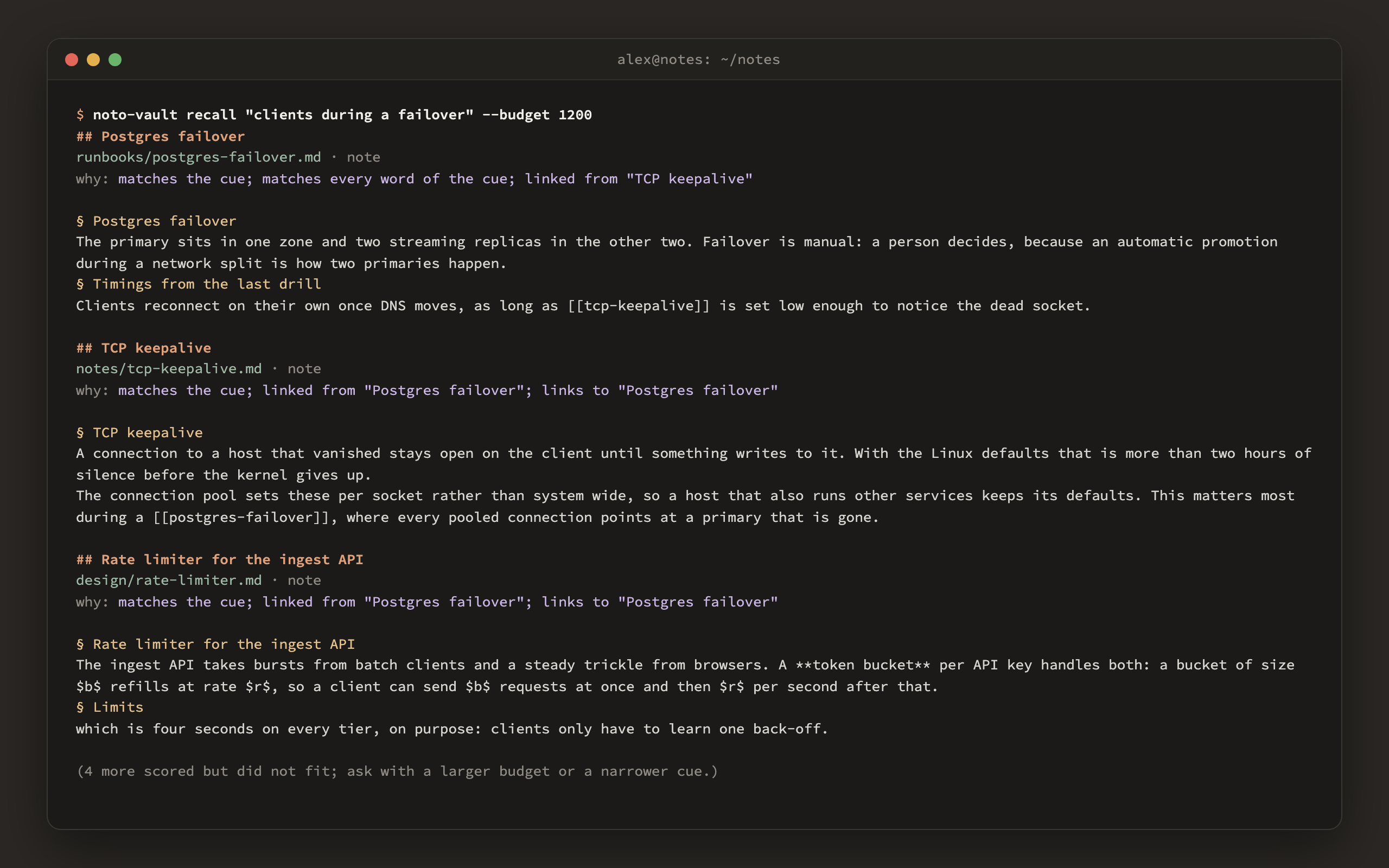
recall returns the notes most likely to matter for a cue, each with its path, its kind, why it was chosen and an excerpt, until the budget in characters is spent, and it records a recall event only for the notes it returns. It works in five steps:
- Seeds: full-text matches for the cue, exact title and alias hits, and the neighbours of the note the caller is in.
- One hop along edges from the best seeds, scaled by edge weight.
- A score: relevance, times kind priority (decisions and cards first, logs last), times
1 + 0.15 ln(1 + heat), times a factor for how the note is known and one for its status. - Drop what the caller may not see, superseded notes whose successor is in the pack, and exact duplicates.
- Excerpts: the paragraphs around the matches, or the head of the note.
Full text over Chinese and English goes through one FTS5 table in which runs of CJK characters are written as overlapping bigrams, so a two-character word matches and a one-character query works as a prefix. Every number above can be tuned under recall: in brain.yaml; these are six of the keys:
| Key | Meaning | Default |
|---|---|---|
kind_weight | score factor per kind | {decision: 1.3, card: 1.2, note: 1, log: 0.85} |
heat | the score is multiplied by 1 + heat ln(1 + note heat) | 0.15 |
limit | notes in a pack when the caller does not say | 12 |
bm25 | BM25 weights of the title, path and body | {title: 8, path: 3, body: 1} |
named | relevance of a note the cue names by title, id or alias | 1.2 |
hop.edge | an association edge of decayed weight w passes edge w / (1 + w) | 0.45 |
A change of numbers can be tried before it is made. --shadow reads the recall: section of another file over the vault’s own, runs the cue under both and records nothing:
$ noto-vault recall "clients during a failover" --shadow heavier-heat.yaml
Recall for "clients during a failover": current config 3bab26d9, shadow 0a4952a9

  #   current                        shadow                         move
  1   runbooks/postgres-failover.md  runbooks/postgres-failover.md  =
  2   notes/tcp-keepalive.md         design/rate-limiter.md         +1
  3   design/rate-limiter.md         notes/tcp-keepalive.md         -1
  4   design/retry-budget.md         design/retry-budget.md         =
  5   notes/load-test-oct-14.md      index.md                       +1
  6   index.md                       notes/load-test-oct-14.md      -1
  7   runbooks/wal-archiving.md      runbooks/wal-archiving.md      =
noto-vault eval scores recall against a file of cases with hit@k, recall and MRR, and takes --shadow too, so a tuning is judged on the vault’s own questions before it is kept.
Keys, scopes and three levels of privacy
Every agent under its own name
.noto/access.yaml names the principals. The person at the command line may do anything. An agent’s key names what it may read, how private a note it may see and which verbs it has; without a key an agent reads what is open and writes nothing. A sealed note is never given to anyone but the person.
sensitivity:
  default: open
  private: ["journal/"]
  sealed: ["vendor/"]

principals:
  default:
    read: ["**"]
    max_sensitivity: open
    verbs: [read, search, recall]
  claude-code:
    keys: [855b91c2...]
    read: ["**"]
    max_sensitivity: private
    append: []
    write: []
    verbs: [read, search, recall, propose]
The MCP server has eight verbs: recall, search, read, append, propose, write, link and supersede, listed only as far as the key allows. Every write names its author, and a write outside the key’s scope must be proposed instead. A key is shown once, and only its SHA-256 is kept in the file:
$ noto-vault key add codex
Added codex to .noto/access.yaml. The key, shown once; give it to the agent as NOTO_VAULT_KEY:
  FAKE-demo-key-not-a-real-one-00
$ noto-vault key revoke codex
The key above is a placeholder in the shape the command prints. The tools that change access.yaml, from the command line or from Noto’s Settings, change only the lines they are about. Each change is parsed back as the server parses it and must equal the old policy with only that change, or nothing is written, so a privacy click cannot quietly drop an agent’s keys or a sealed folder. A running server reads the file again before its next answer, so a revoked key stops working without a restart.
Suggestions and proposals
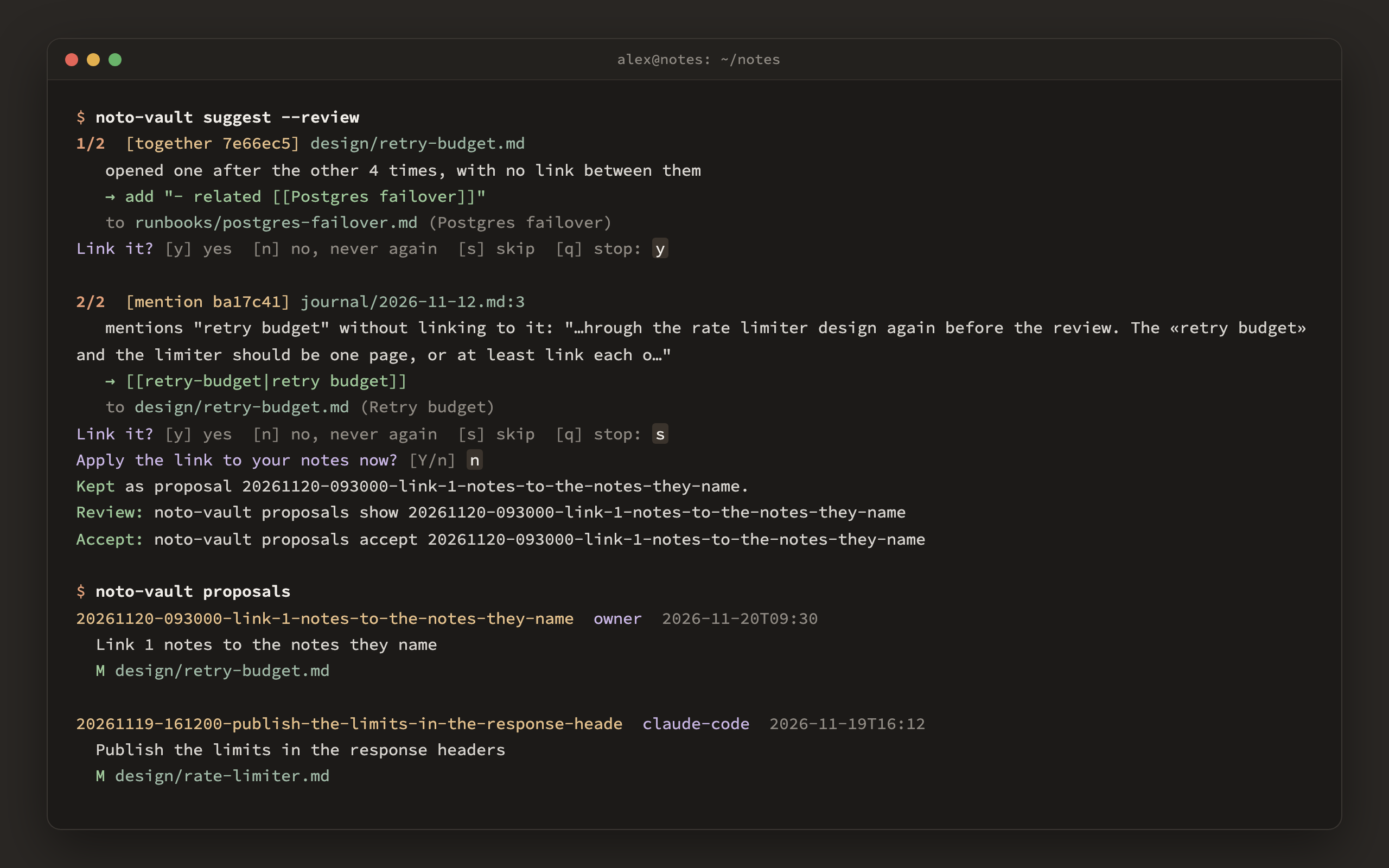
suggest finds the links a vault is missing: a note that names another by its title or an alias without linking it, two notes opened or changed together again and again with no link between them, a link that reaches its note only through an old path, and whatever the vault’s scripts add. Each has an id made from its type, its note and its target, so the same suggestion has the same id on every run. --review goes through a day’s budget of them one at a time, and a no is remembered.
A proposal is how an agent, or a review, changes notes without touching them. It is two commits under refs/noto/proposals/<id>, made with git’s plumbing against a temporary index, so the working tree, the person’s index and their branches are never touched, and nothing pushes them:
flowchart LR
  W["working tree<br/>as it is"] --> B["commit 1: base"]
  B --> C["commit 2: the change<br/>refs/noto/proposals/id"]
  C --> V["review<br/>git diff id~1 id"]
  V -->|"accept"| M["git merge-file<br/>three ways, per file"]
  V -->|"reject"| X["ref deleted"]
  M --> P["the person commits"]
Accepting merges each file three ways, the file now, the base and the proposal, into the working tree, and stops on a conflict for that file. The person commits the result their usual way. What may be touched is checked again on accept: never a file under .noto/, .git or another dot folder.
Inside Noto
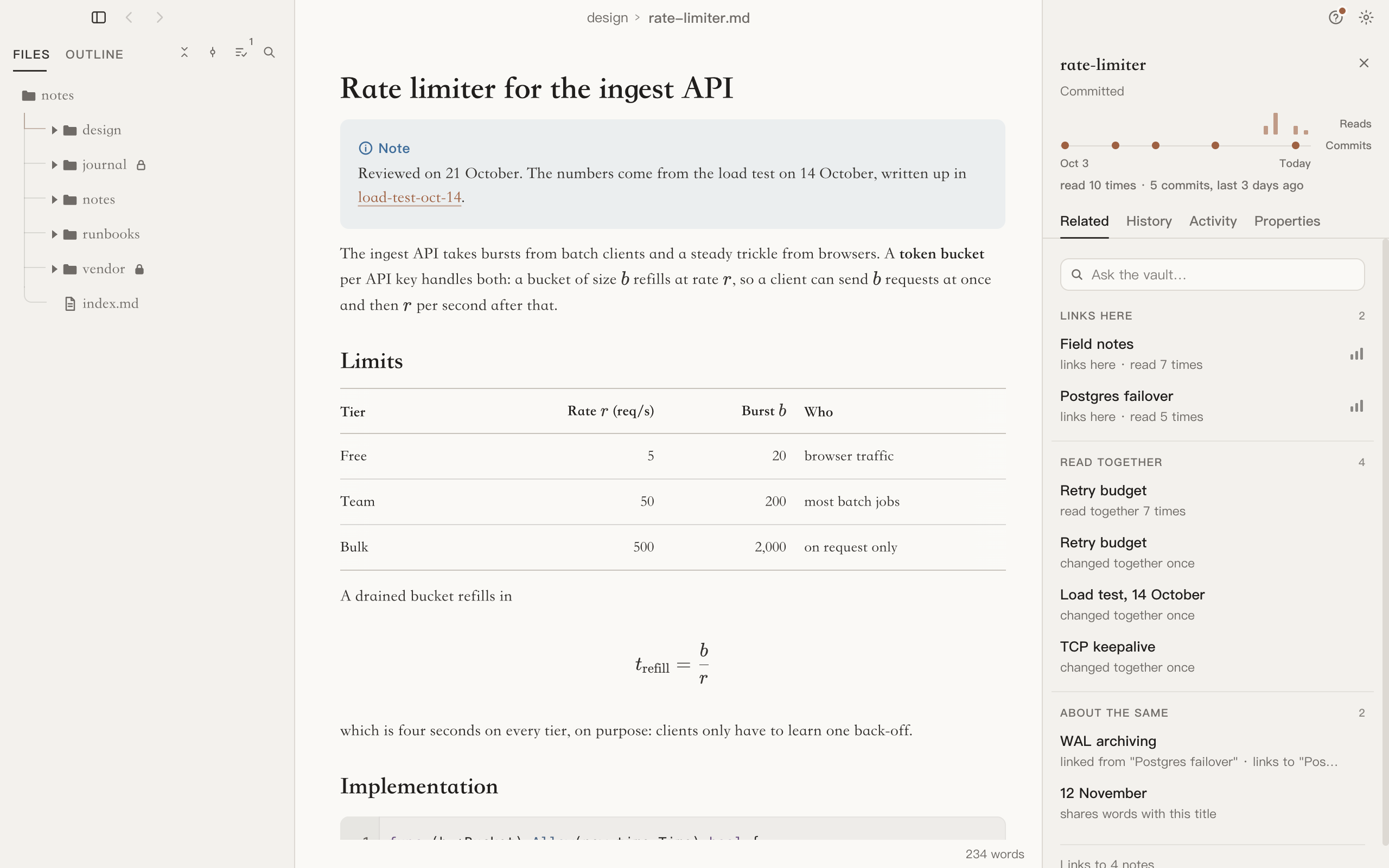
about drawn beside the page.Noto embeds vault since its v0.1.0. Note Info shows what about returns for the note in front, the Review page in the rail lists the suggestions and proposals, and Settings, Memory adds and revokes agents through the same policy edits the command line makes. The Noto page has more of it.
Limits
vault guards agents that reach the folder through its MCP server or its command line with their key. An agent that has a shell and can read files is bounded by the operating system, not by access.yaml; the policy still names the writes it reports through its hook, and keeps sealed notes out of everything vault returns. Scripts in .noto/scripts/ run as code, which is why .noto/ is never writable by an agent.
It is new: v0.2.0 was tagged on 10 November 2026, and it is not on npm. Recall is lexical and structural: full text, links, heat and edges, with no embeddings and no model. The index targets a cold build under 10 seconds and a refresh under 100 ms on a vault of 10,000 notes; the README measures about 9 seconds for 8,000 notes the first time.
Install
- Build it from a tag. Clone
roobli/vault, check outv0.2.1, and runpnpm install && pnpm build. Node 22.13 or later is needed. - Set up a folder. In a folder of notes,
noto-vault initwrites.noto/brain.yaml,.noto/access.yamland.noto/scripts/, andnoto-vault indexbuilds the index. - Give an agent a key.
noto-vault key add claude-codeprints the key once, thenclaude mcp add noto-vault -e NOTO_VAULT_ROOT=$HOME/notes -e NOTO_VAULT_KEY=<key> -- node /path/to/vault/bin/noto-vault.mjs mcpadds the server to Claude Code. - Or open the folder in Noto. Note Info offers to keep memory in a folder that has none, and says what it would write first.
$ pnpm install && pnpm build
$ alias noto-vault="node $PWD/bin/noto-vault.mjs"
$ cd ~/notes && noto-vault init && noto-vault index- Source: github.com/roobli/vault (AGPL-3.0-only)
- Design, with every file format and the access model: docs/design.md